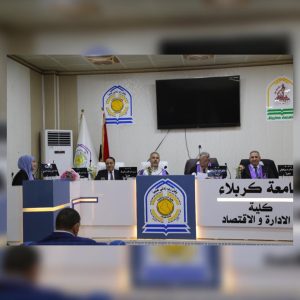

A thesis submitted to the Council of the College of Administration and Economics – University of Karbala, which is part of the requirements for obtaining a master’s degree in economic sciences
Submitted by the student
Alyaa Russian Nasser
Supervised by
Prof. Dr
Hashem Marzouq Ali Al Shammari
Abstract
The research deals with analyzing the effectiveness of the policy of cash sterilization as a tool that central banks use to counter the negative effects of capital flows on the local economy, and the research problem is the question of the extent in which the policy of cash sterilization can contribute to achieving financial stability in the sample countries during the study period, as is the hypothesis of Researching that the policy of cash sterilization plays an active role in achieving financial stability in the sample countries. The most important objectives of the research was to verify the effectiveness of the policy of critical sterilization in achieving financial stability by analyzing the policy tools used as well as calculating the degree of sterilization in the sample countries and its relationship with the indicators of financial stability, and taking advantage of the experiences of the countries chosen in the use of the policy of cash sterilization and the possibility of using some of their tools In Iraq, the importance of research was represented by its role in analyzing the effectiveness of the policy of cash sterilization in achieving financial stability, as this policy contributes to controlling inflation rates, price stability, and enhancing confidence in the local currency. It also helps in controlling the cash supply and reducing the risks associated with unstable cash flows, which contributes to the stability of financial markets and increasing the confidence of individuals in the national currency. Where the policy of critical sterilization has a clear impact on the indicators of financial stability, which will be reviewed by studying the experiences of some selected countries, including Egypt, Algeria, India, and Iraq.
The deductive approach and the analytical method of finding the impact of sterilization policy on financial stability indicators have been adopted. The research reached a set of conclusions, the most important of which is the difference in the effectiveness of the sterilization policy in achieving financial stability from one country to another based on the structure of the economy and the degree of its development, and the structure of the financial system, Iraq’s dependence on the foreign currency window as a major tool for cash sterilization, and lack of interest in other tools such as the discount price, and the percentage Legal reserves, and existing facilities, and the most prominent recommendations were that the policy of cash sterilization should be balanced so that it does not lead to economic recession or strangling the investment activity, with a focus on gradually absorbing excessive liquidity, and applying the policy of cash sterilization effectively, to achieve stability in the exchange rate of the Iraqi dinar Video of foreign currencies, which leads to enhancing confidence in the local economy, developing other sterilization tools such as open market operations and issuing short -term debt tools to reduce excess liquidity in the economy without negatively affecting economic growth.