
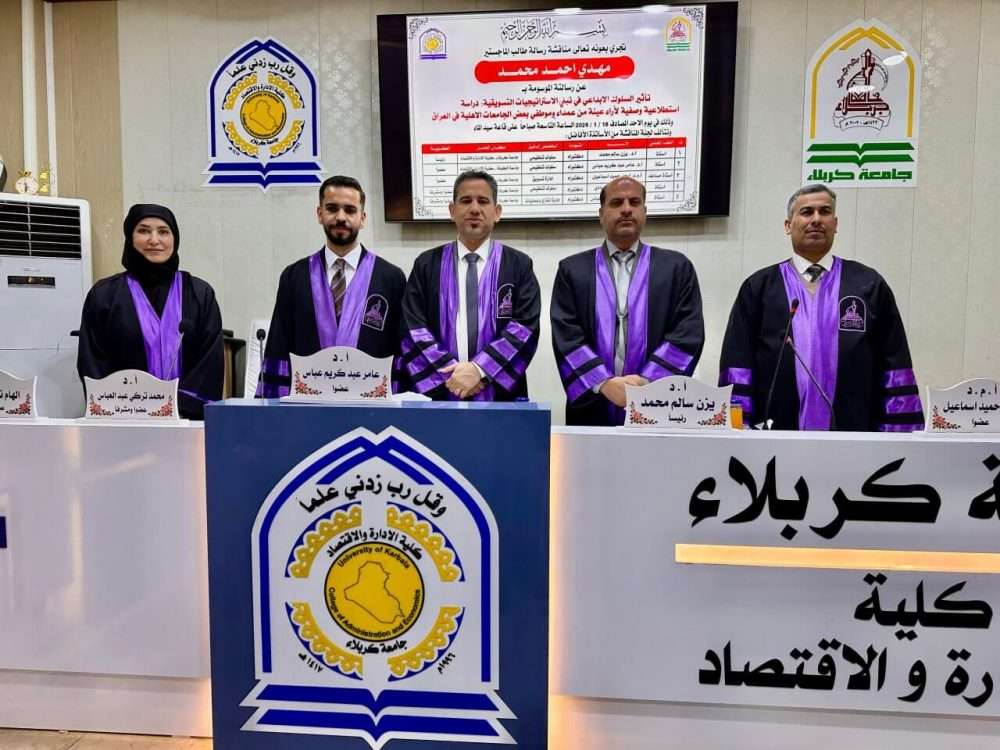
A Thesis Submitted to
The Council of the Faculty of Administration and Economics/ University of Kerbala
As Partial Fulfillment of the Requirements for the master’s degree in business administration
Submitted by:
Mahdi Ahmed Mohammed
Supervised by:
Professor Doctor Alham Nadim Al-Shaibani
Professor Doctor Muhammad Turki Abd al-Abbas
This study aims to analyze the impact of innovative behavior among employees at private universities on the adoption of marketing strategies at the organizational level. Innovative behavior was treated as an independent variable at the individual level, while marketing strategies were studied as three separate dependent variables: offensive, analytical, and defensive strategies. The study employed a descriptive-analytical approach, and a hypothetical model was developed to illustrate the causal relationships between the variables. Data were collected at two levels: at the individual level, innovative behavior was measured through a questionnaire distributed to (170) employees at several private universities in the governorates of Karbala and Baghdad, with an average of
)3–6 (employees per dean. At the organizational level, the three marketing strategy variables were measured through a purposive questionnaire distributed to )50 (deans at these universities. Individual-level data were transformed into organizational-level data using SPSS aggregation. The data were analyzed using SPSS version 26 and AMOS version 23, and the hypotheses were tested using simple linear regression. These hypotheses indicated a statistically significant relationship between creative behavior and each of the three marketing strategy variables (offensive, analytical, and defensive). The results showed a direct and significant impact of innovative behavior on the adoption of the three marketing strategy variables, confirming that enhancing innovative behavior among employees contributes to enabling private universities to develop more effective and competitive marketing strategies.