An analytical survey study of the opinions of a sample of the leadership of the University of Warith Al-Anbiyaa
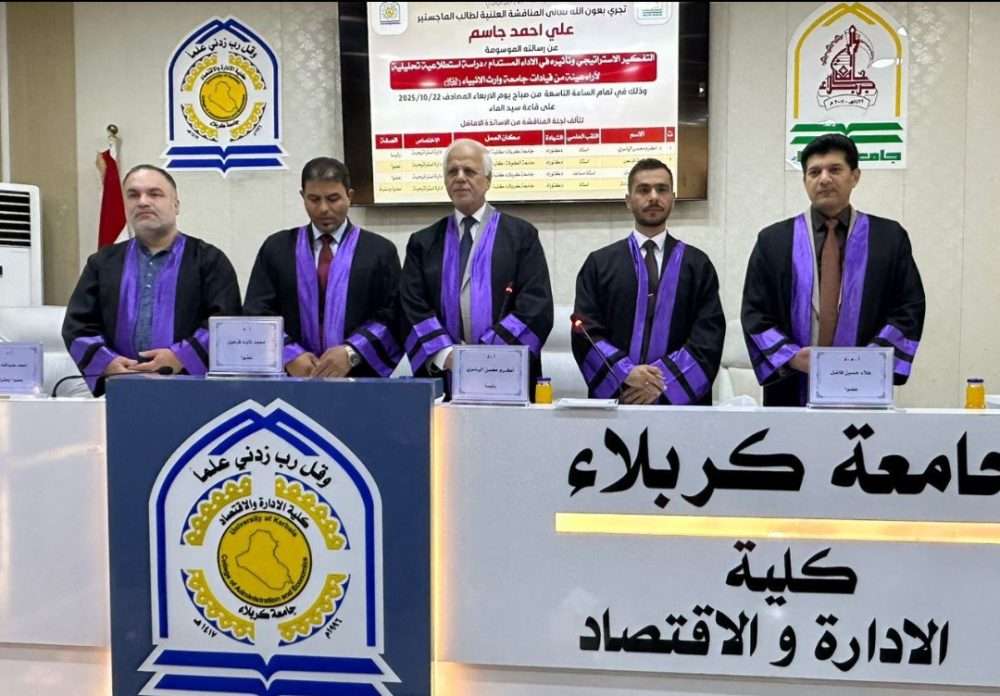
A Thesis Submitted
The Council of The Faculty of Administration and Economics, University of Kerbala, As Part of The Requirements for Obtaining A master’s degree in Business Management
by:
Ali Ahmed jasim
Supervised by:
Prof. Dr. Ahmed Abdullah Amanah Al-Shammari
The study aimed to examine the impact of strategic thinking in its dimensions on enhancing sustainable performance in a private university in the Ministry of Higher Education and Scientific Research. The five dimensions of strategic thinking (Strategic Intent, Time Thinking, Guiding Hypotheses, Seizing Opportunities and Systems Thinking) were adopted based on the study of (Liedtka, 1998), while the dimensions of sustainable performance (Social Performance, Environmental Performance and Economic Performance) were adopted based on the study of (Asiaei, 2021). The study problem was represented by several questions, the most prominent of which was: Does strategic thinking affect enhancing sustainable performance?. The importance of the study emerged in its addressing two main variables in the field of business administration within the private higher education sector, which is one of the sectors that support government higher education, and due to its impact on the social, environmental, economic, and educational aspects of Kerbala society. The University of Warith Al-Anbiya in the holy Kerbala Governorate was chosen as a field for testing the hypotheses of this study. Data were collected through a questionnaire distributed to a purposive sample of (125) individuals from different levels, including (university president, university president’s assistant for administrative affairs, deans of colleges and their assistants, heads of departments and divisions). The data were analyzed using the statistical program (SPSS.v.26) and confirmatory factor analysis using the statistical program (Amos.v.23). The study reached a set of conclusions, the most important of which is the presence of an impact and a direct correlation with moral significance between strategic thinking and its dimensions in sustainable performance. The study also reached a set of recommendations, the most prominent of which is the need for the university under study to pay increasing attention to practicing the components of strategic thinking for university leaders to enhance sustainable performance and thus achieve the components of university sustainability.
Keywords: Strategic Thinking, Sustainable Performance, University of WarithAl-Anbiya.