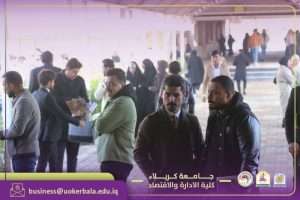

As part of its ongoing efforts to develop the professional and academic skills of its students, the College of Administration and Economics at the University of Karbala held a specialized training course titled:
“Enhancing Students’ Linguistic Proficiency: Mastering Arabic in Administrative Correspondence.”
This course is part of a series of initiatives aimed at preparing students for the demands of the job market and modern educational systems, particularly the Bologna Process.
The course was designed to refine students’ ability to use the Arabic language accurately and professionally within administrative contexts, with a focus on the rules and principles of official correspondence, including style, structure, and linguistic coherence—ultimately boosting their efficiency in administrative and institutional work environments.
The course sessions were delivered by a group of distinguished faculty members:
- Prof. Dr. Ahmed Abdullah Al-Shammari – Department of Business Administration
- Lecturer Dr. Salah Mahdi Jaber – Department of Statistics
- Asst. Lecturer Suad Jabir Sultan – Department of Economics
Key topics covered during the course included:
- Fundamental principles of Arabic administrative correspondence
- Techniques for clear and formal phrasing in letters and reports
- Common linguistic errors and how to avoid them
- Rules of linguistic cohesion and formal layout in written communication
- Practical exercises on writing various types of official letters and reports
The course witnessed high levels of student engagement, with participants showing strong interest in improving their communication skills in this essential area of professional interaction. Real-life examples of administrative correspondence were analyzed and revised during the sessions, reinforcing the practical aspect of the course content.
At the conclusion of the course, the facilitators commended the students for their enthusiasm and active participation. They emphasized the importance of continuing such training programs to bridge the gap between academic theory and practical application—preparing students to be competent contributors in modern work environments. Participants also expressed their appreciation for the instructors’ insightful presentations and valuable content.