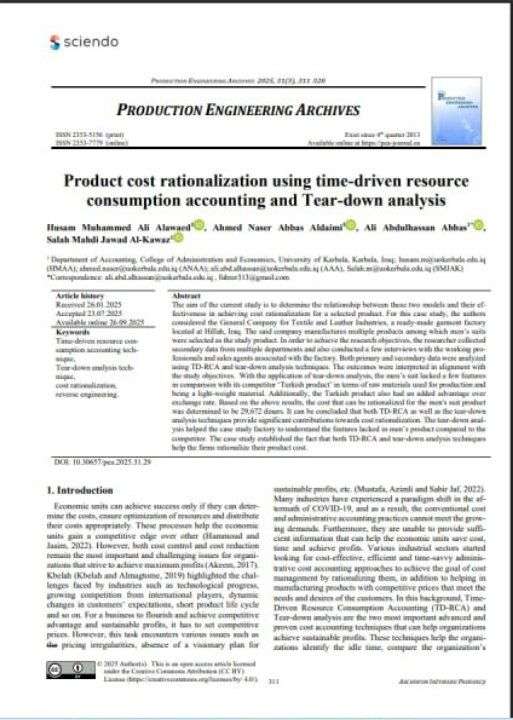
“Product Cost Rationalization Using Time-Driven Resource Consumption Accounting and Tear-Down Analysis” in the journal Archives of Production Engineering (Poland).
About the Journal:
The Archives of Production Engineering (PEA) is a scientific quarterly journal published by the Publishing Office of the Association of Quality and Production Managers, affiliated with the Department of Production Engineering and Safety, Częstochowa University of Technology, Poland. The journal is published under the European publisher Sciendo and is included in the official list of scientific journals recognized by the Polish Ministry of Science and Higher Education.
Abstract:
In the competitive business environment in Iraq, economic units—particularly in the textile sector—face significant challenges in cost reduction and efficiency improvement. This study provides an innovative approach to effectively allocate product costs using two integrated methods: Time-Driven Resource Consumption Accounting (TD-RCA) and Tear-Down Analysis, with a practical application on a men’s ready-made clothing factory in Najaf.
The results showed that applying the TD-RCA technique helped identify unused idle capacity in production processes, amounting to 712 million IQD, highlighting significant resource wastage and the inefficiency of traditional accounting systems. By allocating costs based on the actual time of activities, the recorded product cost was reduced from 3.077 billion IQD to 2.365 billion IQD, demonstrating the technique’s ability to enhance transparency and accuracy in cost accounting.
Meanwhile, the tear-down analysis of the local product compared to a competing Turkish product revealed significant differences in raw materials and design. For example, the Iraqi product used heavier and more expensive materials, while the Turkish product relied on lighter materials and a more flexible design aligned with customer preferences. By simulating the specifications of the competing product, a potential saving of 29,672 IQD per men’s suit was identified without compromising quality.
The study confirms that combining these two techniques not only provides precise information on costs and time but also enables process re-engineering and the adoption of Industry 4.0 technologies, such as artificial intelligence and automation, to improve productivity and sustainably reduce costs.
This research represents a significant contribution to the Iraqi industry, offering a practical model that local companies can adopt to enhance their competitiveness against imported products, emphasizing that cost and time are strategic drivers of market superiority. The study demonstrates that scientific cost allocation is not merely a control mechanism but an investment in competitiveness and financial sustainability, especially in traditional sectors facing fierce global competition.