
The authors are:
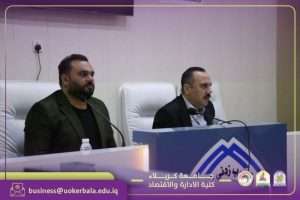
- Prof. Dr. Asaad Mohammed Ali Wahab Al-Awad, University of Karbala, College of Administration and Economics, Department of Accounting.
- Assist. Lecturer Iman Baqir Amin Al-Mousawi, Technical Institute of Karbala, Middle Euphrates University of Technology.
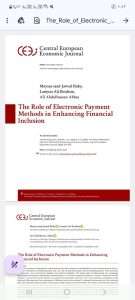
They published this joint study in the International Journal of Management Studies and Social Science Research.
Abstract:
Companies are exposed to audit risks related to fraud and financial statement manipulation. This study aims to measure the level of engineering thinking among external auditors and examine its effect on reducing the risks faced by the accounting and auditing profession in Iraq and globally.
The secondary objective of the study is to determine the extent to which engineering thinking contributes to mitigating audit risks. Practitioners, academics, and professional accounting organizations should address these issues, which auditors have faced during practical work, to enhance the credibility of the auditing profession, protect stakeholders’ investments, and maintain economic stability.
To achieve the study’s objectives, a questionnaire was developed comprising two main sections:
- Section One: Testing the technical proficiency of external auditors, consisting of 23 questions covering four domains:
- Self-assessment of engineering skills
- Engineering mindset
- Engineering thinking process
- Individual growth
- Section Two: Measuring audit risks, consisting of 20 questions covering four domains:
- Mitigation of detection risks
- Internal control risks
- Analytical procedures
- Inherent risks
The study population consisted of auditing firms and public sector auditors in Iraq. A total of 121 participants were randomly selected, and three questionnaires were excluded for unsuitability, leaving 119 valid questionnaires for analysis.
To test hypotheses and draw conclusions, SPSS Version 27.01 was used for statistical analysis, including descriptive statistics, operational analysis, simple and multiple linear regression, correlation, and other techniques.
Results:
- The reduction of audit risks through adopting engineering thinking among auditors was found to be 86.6% correlated.
- All participating auditors agreed on the need to improve their skills in developing test models for internal control systems.
- Most participants emphasized that enhancing engineering thinking skills requires creativity as an integral part of problem-solving in the workplace.